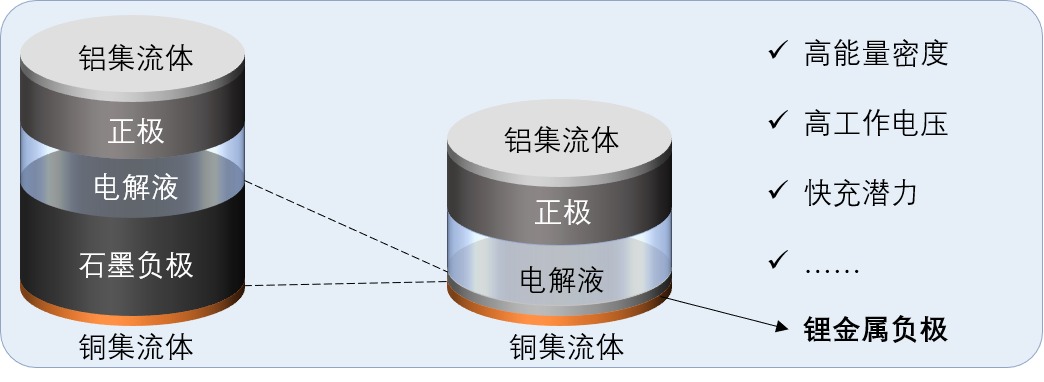
锂金属电池具有高能量密度的优势。我们的研究聚焦于改善锂金属负极的可逆性,通过电解液设计、电极界面优化等途径,解决锂金属沉积不均匀与枝晶生长问题,以提高电池的循环稳定性与安全性。
代表论文:
8. Taming the Ion-Dipole Interaction via Rational Diluent Selection for Low-Temperature Li-Metal Batteries, Angew. Chem. Int. Ed., 2025. https://doi.org/10.1002/anie.202423940
7. N, S-Rich SEI Derived from Continuously-Releasing Additive for Anode-free Lithium-Metal Batteries in Commercial Carbonate Electrolyte, Small, 2025. https://doi.org/10.1002/smll.202410486
6. In-situ p-block Protective Layer Plating in Carbonate-Based Electrolytes Enables Stable Cell Cycling in Anode-Free Lithium Batteries, Nature Mater., 2024. https://doi.org/10.1038/s41563-024-01997-8
5. Rational Anion Selection of the Electrolyte Additive for Highly-Reversible Lithium Plating/Stripping, Adv. Energy Mater., 2023. https://doi.org/10.1002/aenm.202300936
4. Demystifying the Salt-Induced Li Loss: A Universal Procedure for the Electrolyte Design of Lithium-Metal Batteries, Nano-Micro Lett., 2023. https://doi.org/10.1007/s40820-023-01205-3
3. Heterogeneous Nitride Interface Enabled by Stepwise‐Reduction Electrolyte Design for Dense Li Deposition in Carbonate Electrolytes. Adv. Funct. Mater., 2022. https://doi.org/10.1002/adfm.202209384
2. A Stretchable Ionic Conductive Elastomer for High‐Areal‐Capacity Lithium‐Metal Batteries. Energy Environ. Mater., 2022. https://doi.org/10.1002/eem2.12181
1. A“Dendrite-Eating” Separator for High-Areal-Capacity Lithium-Metal Batteries. Energy Storage Mater., 2020. https://doi.org/10.1016/j.ensm.2020.06.037